
The Hidden Snake and the Wise Daughter
 Genre: Moral Fiction, Emotional Drama, Mythological-Inspired Fiction, Inspirational Tales
Once upon a time, in a land rich with forests and ancient temples, there lived a wise sage known for his calm nature and deep wisdom. One day, a traveler came to him with a question that troubled his heart.
“O Sage,” the man said, bowing respectfully, “in your experience, what is the most powerful force in this world? Is it strength, intelligence, or perhaps money?”
The sage smiled. “Let me tell you a story. Through it, you will find your answer.”
There was once a noble king named Veer. He was brave, just, and loved by his people. One day, while hunting alone in the forest, King Veer heard a faint voice calling for help. It was coming from beneath a bush.
Curious and concerned, the king bent down and found a serpent, weak and frightened.
“O great king,” the snake hissed softly, “a hunter is chasing me. If he catches me, I shall not survive. Please hide me in your robe, just for a while. I promise I will not harm you.”
King Veer, being kind and compassionate, agreed. He gently allowed the snake to wrap around his waist under his royal armor.
The hunter passed by without noticing the serpent, and the danger was gone. But when King Veer asked the snake to leave, the snake refused.
“I’m safe here,” said the snake. “Inside your robe, I feel protected and warm. I would rather stay.”
King Veer tried to reason with the snake, but the serpent refused to move. Days passed. The snake lived inside his robe, and King Veer began to feel weaker. His energy faded, and his body felt heavier with each passing day. Eventually, he fell ill and could not return to his kingdom.
Wandering in the forest with pain and confusion, he stayed hidden in a small cottage near a river.
Far away, in a peaceful village, lived a proud and wealthy man with three daughters. One morning, he asked his daughters a question.
“Tell me, my dear children, whose fate do you depend on?”
The two elder daughters, eager to please him, said, “Father, we depend on your fortune. You are the reason we live well.”
But the youngest daughter, Anaya, known for her honesty and self-respect, replied, “I live by my own destiny, Father. My fate is not tied to anyone else.”
Her words struck her father like thunder. In anger, he decided she needed to be taught a lesson in humility. Without much thought, he declared that she would be married to the first stranger who passed their gate that day.
As fate would have it, the stranger was King Veer, now dressed as a poor, ill traveler. The villagers didn’t recognize him as a king. Anaya’s father arranged the marriage immediately.
Anaya accepted her fate without complaint. She could have cried, argued, or blamed her father, but she didn’t. She believed that perhaps her destiny truly had something greater in store.
She moved into the forest with her husband and soon discovered his condition. She took care of him, cooked for him, and gathered herbs to ease his pain. She never asked for more than what she had.
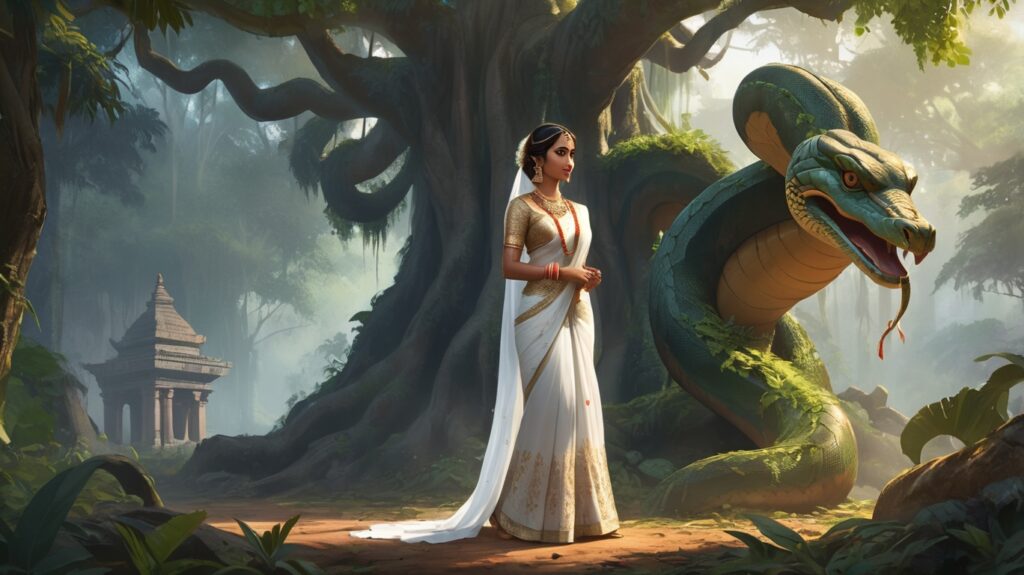
One evening, as Anaya walked through the forest to fetch water, she sat under a banyan tree near an abandoned temple to rest. There, she overheard two snakes talking in whispers.
“You still live inside the king’s body?” asked one snake.
“Yes,” replied the hidden snake. “I’m safe, warm, and he doesn’t know how to get rid of me. He has no idea that if he drinks holy river water, I will be destroyed.”
The other snake hissed back, “And you call me selfish? I’ve been guarding a treasure beneath this very tree, hidden for centuries. But if someone pours mustard oil near the roots, I will die and the treasure will rise.”
Anaya sat frozen. The words echoed in her ears. She returned home quietly and served King Veer a glass of sacred river water, which she had collected secretly. The moment he drank it, he felt a sharp pain in his stomach—and then, relief. The snake inside him had died.
The very next morning, she poured mustard oil at the roots of the banyan tree. Within moments, the ground began to tremble, and from beneath the earth rose an ancient treasure chest filled with gold, silver, and precious stones.
With the treasure, Anaya built a beautiful house in the forest for them to live in peacefully. Slowly, King Veer recovered completely and began to regain his strength.
Meanwhile, in another town, Anaya’s father lost everything during a sudden invasion. With no home or money, he wandered toward the same forest, hoping to find help.
One evening, he knocked on the gates of a large home built of stone and wood. When the door opened, he was shocked. Standing before him was Anaya, his daughter—clothed in dignity, surrounded by prosperity.
He fell to his knees. “I have nothing left. My pride is broken,” he wept.
Anaya lifted him up gently and said, “Come, Baba. This is your home too.”
Her father couldn’t stop his tears. He understood now—fate was powerful, but time was supreme. The daughter he once tried to humble with punishment had become the source of his shelter and survival.
He stayed with Anaya and King Veer, serving them with gratitude. His ego melted. Every day, he told people, “I once believed I controlled destiny. But now I know—time is the greatest power of all. It can turn a king into a beggar, and a beggar into a king.”
Moral of the Story:
Time is the most powerful force. Ego, pride, and wealth can disappear in a moment, but truth, wisdom, and kindness last forever. Never underestimate destiny, and always respect time.